










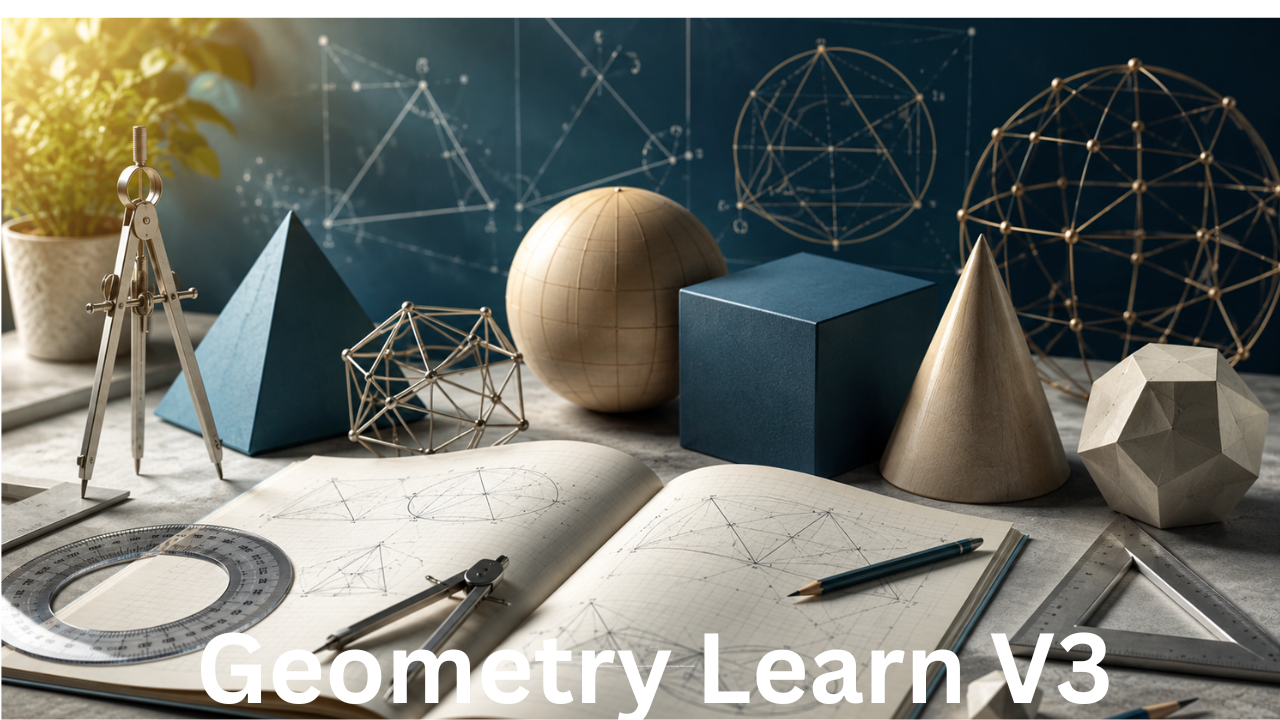
Geometry is one of the most important branches of mathematics, but many students struggle to understand shapes, angles, formulas, and proofs. Modern learning platforms have made studying geometry easier than ever, and Geometry Learn V3 has become a keyword that many students search for when looking for interactive geometry learning resources.
Whether you’re a beginner trying to understand the basics or a student preparing for exams, this guide explains what Geometry Learn V3 is, its features, benefits, learning methods, and how you can use it to improve your geometry skills.
What Is Geometry Learn V3?
Geometry Learn V3 generally refers to a modern, interactive approach to learning geometry through digital tools, visual demonstrations, and practice exercises. Instead of relying only on textbooks, learners can explore geometric concepts using diagrams, animations, and step-by-step explanations.
The goal is to make geometry easier to understand by helping students visualize mathematical ideas rather than simply memorizing formulas.
Geometry learning platforms inspired by this approach often include:
- Interactive lessons
- Practice quizzes
- Visual diagrams
- Shape construction tools
- Instant feedback
- Progress tracking
These features help students build confidence while learning at their own pace.
Why Geometry Is Important
Geometry is much more than calculating angles or drawing triangles. It develops logical thinking and problem-solving skills that are useful in everyday life.
Geometry plays a major role in:
- Engineering
- Architecture
- Graphic design
- Computer science
- Robotics
- Game development
- Construction
- Physics
- Surveying
- Interior design
Even careers involving 3D modeling, animation, and artificial intelligence rely heavily on geometric principles.
Key Topics Covered in Geometry Learn V3
A comprehensive geometry learning system typically includes lessons covering every major concept.
| Topic | What You’ll Learn |
|---|---|
| Points & Lines | Basic geometric definitions |
| Angles | Types of angles and measurements |
| Triangles | Properties, congruence, similarity |
| Quadrilaterals | Squares, rectangles, rhombuses, trapezoids |
| Circles | Radius, diameter, chords, arcs |
| Polygons | Interior and exterior angles |
| Coordinate Geometry | Distance, midpoint, slope |
| Transformations | Rotation, reflection, translation |
| Surface Area | 3D shapes and calculations |
| Volume | Cubes, cylinders, cones, spheres |
Learning these topics step by step creates a strong mathematical foundation.
Features of Geometry Learn V3
One reason students prefer modern geometry platforms is their interactive learning experience.
Interactive Diagrams
Instead of static images, diagrams can be moved, rotated, resized, and explored. This helps students understand how geometric properties change.
Step-by-Step Solutions
Rather than displaying only the final answer, solutions explain every calculation.
This makes it easier to understand:
- Why each step matters
- Which formula is used
- How mistakes occur
Practice Exercises
Regular practice helps reinforce learning.
Exercises usually include:
- Multiple-choice questions
- Drag-and-drop activities
- Shape identification
- Angle calculations
- Proof problems
Instant Feedback
Immediate feedback helps learners identify mistakes quickly instead of repeating them throughout the lesson.
Progress Tracking
Many digital learning systems monitor:
- Completed lessons
- Quiz scores
- Improvement over time
- Weak areas requiring more practice

Benefits of Using Geometry Learn V3
Students often perform better when learning becomes visual and interactive.
Some major benefits include:
- Easier understanding of complex concepts
- Better retention through visual learning
- Increased confidence
- Flexible self-paced learning
- Less dependence on memorization
- Improved exam preparation
- Higher engagement than traditional textbooks
Interactive learning also reduces frustration by allowing students to experiment with shapes and measurements.
Who Can Use Geometry Learn V3?
Geometry Learn V3 can be useful for a wide range of learners.
School Students
Students in middle school and high school can strengthen classroom learning.
College Students
Basic geometry remains important in engineering, architecture, and technical programs.
Teachers
Teachers can use interactive demonstrations during lessons to make difficult concepts easier.
Parents
Parents helping children with homework often find visual explanations easier than textbook-only methods.
Competitive Exam Candidates
Many standardized tests include geometry questions involving:
- Angles
- Triangles
- Coordinate geometry
- Circles
- Area and volume
Practicing regularly improves speed and accuracy.
Best Ways to Learn Geometry Faster
Success in geometry requires understanding rather than memorization.
Here are several effective strategies:
- Practice drawing diagrams.
- Learn one concept before moving to the next.
- Solve problems every day.
- Review incorrect answers carefully.
- Understand formulas instead of memorizing them blindly.
- Use visual tools whenever possible.
- Break difficult proofs into smaller steps.
Consistency matters more than studying for long hours occasionally.
Common Geometry Formulas Every Student Should Know
Some formulas appear repeatedly in exams.
Area Formulas
- Square = side × side
- Rectangle = length × width
- Triangle = ½ × base × height
- Circle = πr²
Perimeter Formulas
- Square = 4 × side
- Rectangle = 2(length + width)
- Circle (Circumference) = 2πr
Volume Formulas
- Cube = side³
- Rectangular prism = length × width × height
- Cylinder = πr²h
- Sphere = 4/3 πr³
Understanding when to apply each formula is more important than memorizing long lists.
Common Mistakes Students Make
Even good students make errors while solving geometry problems.
Some common mistakes include:
- Reading diagrams incorrectly
- Forgetting measurement units
- Using the wrong formula
- Miscalculating angles
- Skipping proof steps
- Rounding numbers too early
Carefully reviewing each solution helps avoid repeated mistakes.
Tips for Exam Success
If you’re preparing for a geometry exam, consider these practical tips:
- Review formulas regularly.
- Practice previous exam papers.
- Draw clear diagrams.
- Label all known measurements.
- Show every calculation step.
- Double-check angle sums.
- Manage your time effectively.
Small improvements in accuracy often lead to significantly better scores.
How Interactive Learning Improves Geometry
Traditional learning often depends on reading definitions.
Interactive learning adds:
- Visual demonstrations
- Real-time manipulation of shapes
- Animated explanations
- Guided problem solving
- Immediate correction
This approach helps students understand why geometric rules work instead of simply accepting them.
Is Geometry Learn V3 Good for Self-Study?
Yes. One of its biggest advantages is flexibility.
Self-learners can:
- Study anytime
- Repeat lessons as needed
- Practice unlimited questions
- Track progress independently
- Focus on weak topics
This makes it suitable for students who want additional practice outside the classroom.
Frequently Asked Questions
What is Geometry Learn V3?
Geometry Learn V3 refers to a modern, interactive approach to learning geometry using visual lessons, practice exercises, and digital tools that simplify mathematical concepts.
Is Geometry Learn V3 suitable for beginners?
Yes. Beginners can start with basic concepts like points, lines, and angles before progressing to more advanced topics such as transformations and coordinate geometry.
Can Geometry Learn V3 help with school exams?
Absolutely. Regular practice and step-by-step explanations can improve understanding, accuracy, and confidence for classroom tests and competitive exams.
Do I need advanced math knowledge?
No. Most geometry learning resources begin with fundamental concepts and gradually introduce more challenging material.
Why is visual learning important in geometry?
Geometry is highly visual. Seeing shapes, angles, and transformations makes it much easier to understand relationships that are difficult to grasp through text alone.
Final Thoughts
Geometry doesn’t have to be difficult. With modern learning methods like Geometry Learn V3, students can move beyond memorization and develop a deeper understanding of mathematical concepts through visualization, practice, and interactive learning.
Whether you’re preparing for an upcoming exam, improving classroom performance, or simply strengthening your math skills, a structured geometry learning approach can make the subject more enjoyable and easier to master. By practicing consistently, reviewing mistakes, and focusing on understanding rather than memorization, you’ll build lasting confidence in geometry and be better prepared for future mathematical challenges.
Also Read: The Online Game Event UndergrowthGameLine: Everything You Need to Know



One thought on “Geometry Learn V3: A Complete Guide for Students, Teachers, and Self-Learners”
Comments are closed.